
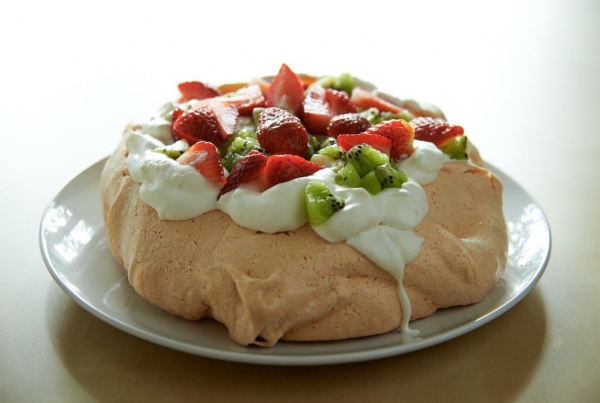
Despite it's unassuming apperance Pavlova (a sweet meringue-like dessert) created a decades-long culinary war between New Zealand and Australia. Due to its airy consistency (inspired by ballet dancer Anna Pavlova), the dessert is especially perfect for the summer months as it can be topped with all kinds of seasonal fruit.
>Pavlova is a sweet meringue-like crust that is topped with whipped cream and fresh fruit. The dessert itself was named after the Russian ballet dancer, Anna Pavlova, who visited Australia and New Zealand in the 1920s. She created such a frenzy with her visits that during the decades to follow it, the name “Pavlova” was used for all kinds of desserts, from trifle-like, gelatin-based creations to cakes and meringues in various forms.
According to Anna Pavlova's biographer, Keith Money, the original dessert to honor the famous ballet dancer, was created in 1926 by a chef at a hotel in Wellington (New Zealand) who drew the inspiration for the dessert from one of Pavlova's tutu's that was covered in netting and green silk roses. The first official recipe of Pavlova—the way we know it today—was published in 1929 in the New Zealand Rural Magazine. However, it wasn't until 1935 that a Perth (Australian) chef Bert Sachse developed his Pavlova recipe, that the name and recipe became more widely known around the world. Currently, most sources agree that Pavlova was first created in New Zealand, although both Australia and New Zealand have contributed to its present form.
Traditionally, Pavlova is made by beating egg whites to a stiff consistency and then folding in sugar, white vinegar, cornstarch, vanilla extract, and cream of tartar (a thickening and rising agent). Cream of tartar can be substituted for lemon juice or extra white vinegar to achieve a similar result. After mixing, the mixture is baked slowly, similarly to a meringue.
The main difference between Pavlova and meringue is the addition of cornstarch, which changes the consistency of the dessert. Unlike meringue which is solid throughout, Pavlova has a crisp outer shell, but a soft, marshmallow-like inside. The addition of cornstarch also makes Pavlova significantly more fragile than a meringue. As Pavlova is notorious for deflating if exposed to cold air, it is very important to leave it in the oven to fully cool down before the oven door is opened.
Before serving, top the Pavlova with whipped cream and chopped fresh fruits. Most of the traditional Pavlova recipes call for strawberries, passion fruit and kiwis to decorate the dessert. In principle, however, any seasonal fruit can be used (raspberries, blueberries, pineapple, pomegranate seeds, mango, etc.). Some of the recipes even include pistachio nuts or almonds.
Although it might seem a bit strange to see a dessert that uses fresh fruit as a traditional Christmas dessert, it makes perfect sense when we think of the location of these countries in the Southern Hemisphere.
The Christmas season in Australia and New Zealand is not about snow, sleigh bells and reindeer, but about barbecues, sun and Pavlovas.
Take a chance and bring some Christmas feeling into your summer this year!
Ingredients:
For the Pavlova:
- 4 large egg whites at room temperature
- 1 cup white sugar
- 1 teaspoon white vinegar
- 1/2 teaspoon vanilla extract
- 1 tablespoon fresh lemon juice
- 1/2 tablespoon cornstarch
For the topping:
- 1 cup whipping cream
- 2 tablespoons sugar
- 3 kiwis
- 1/2 pound strawberries
- 2 passion fruits
Preparation
- Preheat the oven to 275 degrees F (140 degrees C) and place the rack in the middle of the oven.
- Line a baking tray with parchment paper and draw a 7 inch circle on it. Set aside.
- Clean the bowl and all the utensils to make sure that no grease particles get into the mix.
- Beat the egg whites in a medium-sized bowl with an electric mixer on medium speed until the whites form soft peaks.
- Be careful not to overbeat them as then they will deflate when being mixed with other ingredients.
- Gently sprinkle the sugar into the egg whites, one teaspoon at a time. Be careful not to stop beating the eggs until you have added all the sugar.
- Continue beating until you have glossy stiff peaks.
- Mix cornstarch, lemon juice and vinegar together.
- Fold them in gently to the egg whites with a spatula.
- Add the vanilla extract and gently fold the mixture again.
- Gently spread the mixture in the circle on the parchment paper.
- Make sure the edges of the Pavlova are slightly higher than the center so you have slight depression in the middle.
- Bake the Pavlova for about 1 hour and 15 minutes or until it has a slightly pinkish egg shell color.
- Turn the oven off and leave the door slightly ajar to let the Pavlova cool completely. The Pavlova might crack slightly as it cools.
- Take the Pavlova out of the oven just before serving.
- Remove it gently from the parchment paper and place it on a flat serving plate.
- Whip the cream with the sugar until it forms peaks. Be careful not to whip it for too long.
- Prepare the fruit by washing it and slicing it in the desired way.
- Gently spread the cream over the top of the Pavlova with a spatula and place the fruit on top.
- Serve immediately.
Recipe by Mari-Liis Muiste
Photo by Heidi Adams

- Details
- Hits: 5475
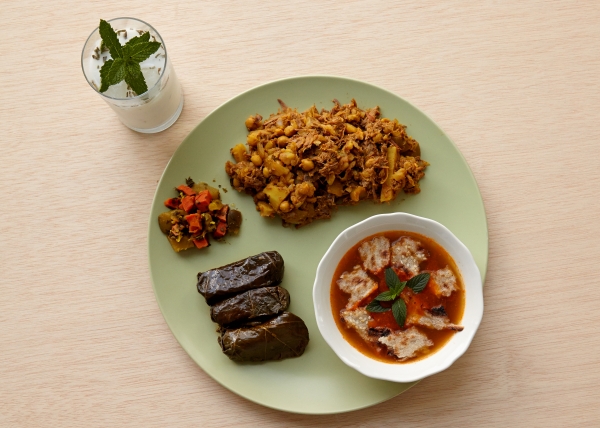
Persian Abgoosht with Doogh is a hearty stew made with meat and garbanzo beans. Historically a peasant and laborer food, it is now enjoyed by Iranians from all walks of life.
In Farsi (the language spoken by Iranians) abgoosht, sometimes spelled "ab-goosht" when rendered in the Roman alphabet, is a contraction or portmanteau of ab meaning “water” and goosht a general term for "meat", but it refers to various forms of stew. It is usually made with lamb in Iran, but beef can also be used.
Abgoosht is traditionally cooked in small clay pots called dizi and cooked slowly over a charcoal fire. At Abgoosht shops, many dizi are cooked at the same time. The dizi are also used as serving vessels, so abgoosht is also colloquially known as dizi. Finding a dizi to cook abgoosht in might be a challenge here in the States, a Dutch oven over low heat or even better a crockpot (my 30 year old one has a ceramic interior) works fine. It seems possible that you could speed the cooking time up with a pressure cooker, but the potatoes would have to be cooked subsequently or they will be mushy.
The most unusual ingredient used in abgoosht is black-lime, known at limo amani or simply dried lime. Dried limes can be purchased at the Balboa Market (near Genesee Ave.). Dried limes are used as flavoring through out the Eastern Mediterranean and Middle East. If you are looking to explore other recipes with dried limes, try the Syrian kapsa recipe found in the Participant Observer Cookbook. Dried limes are more of a flavoring than something to be eaten directly (although this can be done), but beware they are rather tart and strong tasting. During cooking they become soft. Poking holes in them before they are added to the pot allows liquid to infuse into the lime and thereby release its flavor. Lime juice can be used as a substitute although the flavor is quite different.
What sets abgoosht apart from other stews is it's final preparation. After the stew cooks for 3-4 hours, it is drained with a colander and the resulting broth is reserved. The remaining solids are then mashed with a pestle (similar to one found a in mortar and pestle set) known as a goosht koob. The amount of mashing seems to depend on personal preferences but it often ends up much like a rather smooth meat-vegetable pâté. The soup part is eaten first. Often pieces of dried flatbread (sangak, barbari, lavash or even pita) are broken off into the soup just before eating it. Balboa Market sells fresh flat breads like sangak (which is a huge single piece of flatbread).
After the soup is eaten, the solid abgoosht is then eaten with a fresh (not dried) flat bread. Spring onions, fresh mint, radishes and small slices of fresh lime can also be eaten with the abgoosht. A special mixed-vegetable pickle known as torshi is also a normal accompaniment for this meal. A very easy to make mint yogurt drink known as doogh offers a minty cool compliment to the thick stew and the astringent sour of the torshi pickle. Sometimes Abgoosht is used as a sandwich filler.
Notes:
Some cooks simply put whole onions, whole tomatoes, meat (lamb or beef), water, limes, garbanzo beans and spices in the pot and cook it slowly for several hours (again adding the potatoes in the last hour). Cutting everything up into smaller bits certainly makes mashing things easier. Bone-in cuts of lamb or beef (shanks) are preferred for the marrow. Garbanzo (Nakhod) beans are a key ingredient, but sometimes white beans, kidney beans or black-eyed peas are added with the garbanzo beans.
Abgoosht is mostly associated with cold winter weather, but it really can be enjoyed any time of the year.
Ingredients:
- 1 and a half pounds of beef shanks
- 1 larger or two medium onions (chopped coarsely)
- 3-4 garlic cloves
- 1 cup of canned garbanzo beans (drained)
- 2 dried limes
- 3-4 medium sized tomatoes
- 2 tablespoons tomato paste
- 3 medium sized potatoes cut into medium sized chunks
- 2 tablespoon turmeric
- 1 tablespoon ground cinnamon
- 6 cups of water
- Salt and pepper to taste
Preparation:
- Cut up onions and put them on the bottom of the crockpot or heavy pot. Add meat, tomatoes, tomato paste, garlic cloves, garbanzo beans, spices and 6 cups water.
- Bring to a low simmer
- Poke a couple of holes in the each of the dried limes and add them to the pot, pushing them down so that they fill with liquid.
- Cover and cook on low heat for 2 ½ to 3 hours until the tomatoes completely dissolve and the meat is falling off the bone.
- Add potatoes, cover the pot again and cook everything until the potatoes are fork-soft but not mushy.
- Add salt and pepper to taste. To bring out the richness of the dish, you might have to use a bit more salt than you usually do. If you have high-blood pressure or other conditions that require you to restrict your salt intake, adjust the amount of salt according to your needs.
- After the potatoes are fully cooked and the meat is very tender, place a colander in a pot or large bowl and drain the liquid from the solids.
- Return the solids to the cooking pot and have at them with a potato masher. Again personal preference dictates how much mashing you should do.
- If necessary, reheat the broth and then serve it in bowls. Breaking bits of dried flat bread into the broth is a common way of eating the broth.
- 10. Serve the abgoosht on a plate along with torshi pickles. Dolmas (Domeh as shown in the photo) also go well with this meal. Small slices of lime, mint leaves and spring onions add a nice touch.
Doogh (Yogurt-Mint Drink)
Doogh is an easy to make yogurt-mint drink. Mix a half cup of Greek style yogurt with two cups of either club soda, sparkling water or regular water. Add a heaping teaspoon of dried mint or finely chopped fresh mint, a pinch of salt and even a very small amount of pepper to the concoction. Serve over ice. Add a sprig of fresh mint to add a final bit of panache and minty aroma.
Befarma'id! بفرماييد (Bon Appetite in Farsi)
Recipe by Tom Johnston-O'Neill
Photo by Heidi Adams
- Details
- Hits: 7067
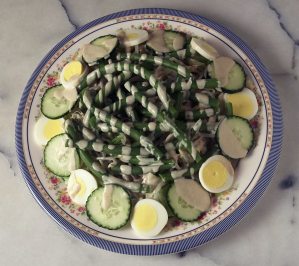
Similar to Indonesian Gado-Gado, Surinamese Goedangan is vegetable salad that employs a unique and refreshing (perfect for summertime) coconut/yogurt dressing.
Surinam is a country on the Northeast coast of South America. It is a relatively small country with only slightly more than a half-a-million people. In spite of its small size, it is remarkably culturally diverse. Little more than a third of the population is descended from South Asia (India). Creoles are the second largest group followed by people from Javanese, Chinese and African descent. Indigenous people only account for about 2 percent of the population. With such ethnic diversity comes culinary diversity too.
Goedangan was undoubtedly influenced by Javanese cuisine. It is very similar to Gado-gado, which was the very first Participant Observer Recipe of the Month and is an absolute favorite of some of our readers. Instead of a spicy peanut sauce, Goedangan calls for a mildly-spicy yogurt and coconut cream sauce. The sauce, together with the crunchy parboiled vegetables and cucumber, make this a cooling summertime dish.
Preparation Notes: Most (but not all) of the vegetables in this recipe need to be parboiled. This will require you to have a large pot of salted boiling water. After they are parboiled, it is best if the vegetables are rapidly cooled in ice water, which will keep them slightly crisp. Parboiling the vegetables in batches (using the order specified below) will allow you to arrange the ingredients in an eye-pleasing manner.
Ingredients:
- 1 medium head cabbage
- 1 pound of green beans
- 2 cups mung bean sprouts
- 1 cucumber
- 1 medium sized carrot, thinly sliced
- 6 hard-boiled eggs
- 1/3 cup coconut cream
- 1/2 cup plain yogurt
- 3 tablespoons dark brown sugar
- 1 green chili pepper seeded and finely chopped
- 1 teaspoon ground coriander
- 1 lime (juice)
- salt to taste
Preparation:
- Make hard-boiled eggs in your favorite manner. A good foolproof method is to place eggs in a medium to large pot of cold water, bring it to a boil and then cover the pot and turn off the heat. Twenty minutes later the eggs will be perfectly cooked.
- Blend coconut cream and yogurt in a mixing bowl.
- dd minced green chili, brown sugar, coriander, lime juice, and salt to the coconut and yogurt blend..
- Chill the mixture in refrigerator
- Slice cabbage into thin strips
- Parboil the cabbage for 2 minutes and then transfer to the bowl of ice water.
- After the cabbage cools, remove and arrange it on a serving platter
- Parboil the bean sprouts for 3 minutes and then transfer to the bowl of ice water
- After the bean sprouts cool, transfer them to the serving platter (on top of the cabbage). Neatness and artistry counts!
- Parboil the green beans for 4 minutes and then transfer to the bowl of ice water
- After the green beans cool, transfer them to the serving platter (on top of the cabbage and sprouts)
- Slice the cucumber into 1/4 inch slices. If you score the cumber lengthwise with the tines of a fork, they will look nice
- Slice the hard-boiled eggs
- Arrange all the ingredients on the platter as shown in the picture above
- Drizzle with the chilled coconut/yogurt dressing and serve extra dressing on the side for diners who want more.e.
Eet smakelijk! (bon appétit in Dutch, the official language of Surinam).
Recipe by T. Johnston-O'Neill
Photo by Heidi Adams
- Details
- Hits: 5926
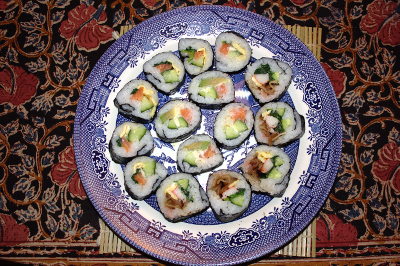
Eho-maki and California Sushi Rolls Eho-maki are a traditional seaweed wrapped sushi that can be enjoyed anytime during the year, but they have a central role in a Japanese festival, Setsubun, that takes place on February 3rd every year. Although the weather is still very cold in Japan, this event marks the beginning of Spring in the traditional calendar and it is now often a part of Haru Matsuri spring festivals. The celebration is otherwise known as the "bean throwing festival" (mamemaki). During this festival day, Japanese (particularly Japanese Buddhists) throw roasted soybeans at shrines, temples, and in some places, masked characters oni,(usually the senior male in a household) who play act like scary demons. The bean throwing drives away misfortune and evil spirits. Celebrations have become very elaborate at the larger temples. Sometimes the ritual is observed with specific dances, role-reversals (including cross-dressing and young people dressing like old people), special household decorations (including hanging sardine heads!) and the bringing of outdoor work tools inside homes to protect them from marauding and ill-tempered spirits. Ginger flavored sake is a popular drink on this day. Setsubun celebrations are most popular in the Kansai region where it is believed that they originated in, but are now celebrated nation-wide.
The Eho-maki rolls, which in addition to rice and nori (seaweed) have seven different fillings that symbolize the Seven Deities of Good Fortune (Shichifukujin). Ingredients often include: egg, spinach, crab (artificial or real), gourd strips (kanpyo), sweet fish powder (sakura denbu), cucumber and shitake mushrooms. Other versions might substitute eel or seasoned freeze-dried tofu (koyadofu). Normally, sushi rolls are cut into bite sized slices. However, for Setsubun are eating without being sliced. On the evening of Setsubun, participants face the current year's Zodiac constellation (the direction of good fortune), silently saying a prayer for good luck, and then eat the Eho-maki bite by bite until it is all finished. As Eho-maki rolls are rather large, this can sometimes be challenging!
All of the Japanese ingredients and equipment may be purchased at the Mitsuwa Marketplace or any other local Japanese grocery store. Helpful and Necessary Equipment:
- Rice cooker
- Large flat rice spoon
- Small cooking pan
- Small (9-inch) frying pan
- Large flat serving dish (really large)
- Japanese or other hand fan (optional)
- Sushi Rolling Mat
INGREDIENTS
- 2 cups Japanese short-grain rice
- 1 package of Nori (seaweed)
- 2 tablespoons of Japanese sweet sake (Mirin)
- 4 tablespoons of Japanese rice vinegar
- 5 tablespoons of sugar
- 3 teaspoons of salt
- Soy sauce
7 Ingredients for Sushi Filling.
- 1 egg
- 1 bunch of spinach
- 1/2 cup dried shiitake mushroom pieces (not whole!)
- 1 small package of Japanese imitation crab (kanikama)
- 1 package dried gourd strips (kanpyo)
- 1 package sweet fish powder (really just for looks, it's bright pink!)
- 1 Japanese cucumber
PREPARATION:
Rice:
- Cook 2 cups of Japanese rice according to directions on the package (amount of water varies)
- While rice is cooking, prepare the other ingredients below and then return to the next step here to finish the rice
- As soon as the rice finishes cooking, pile it into a very large flat bowl
- Drizzle all the seasoned vinegar on the rice and mix the rice very very gently so that the vinegar coats as much rice as possible
- Spread the rice out in the bowl so that it is a thin layer. Do this very gently so as to avoid breaking the rice kernels
- For absolutely perfect sushi rice, vigorously fan the rice with a hand fan to cool it rapidly (this step often separates good sushi from mediocre sushi, so it is highly recommended!
Fillings:
Shitake Mushrooms
- Soak shitake mushrooms in warm water for 10 minutes
- Drain most of the mushroom water and reserve in a cup or bowl
- Add 1 tablespoon each of soy sauce, sugar, and sweet sake to remaining water with the softened mushrooms
- Gently boil mushroom until almost all of the liquid is absorbed or has evaporated
- Remove mushrooms and let cool
Gourd Strips
- Soak the gourd strips in cold water for 10 minutes
- Drain all of the water
- Pour the reserved mushroom water in a pot and add the softened gourd strips
- Add 1 tablespoon each of soy sauce, sugar and sweet sake to remaining water with the softened gourd strips
- Gently boil the gourd strips for ten minutes
- Remove gourd strips and let cool
Cucumber
- Cut cucumber into 4 lengthwise
- Carve away the seeds
- Slice cumbers into 3/8th inch strips
Eggs
- Mix, but don't beat two eggs in a bowl
- Pour mixed eggs into a medium oiled or buttered 9-inch frying pan and make a flat omelette
- Remove from pan, cool the omelette and then cut into long strips
Spinach
- Boil whole spinach leaves in water until softened
Rolling the Sushi
Sushi seaweed (nori) has a shiny side and a dull side. The shiny side should be placed face down on the sushi mat so that it will be on the outside of the finished sushi roll. Thinly spread rice on the lower 3/4 of the nori. The upper 1/4 (away from you) should be empty. In the middle of the rice place all the ingredients aligned left to right. Sprinkle everything with the sweet fish powder. At the two edges closest to you, pinch the sushi mat and the corners of the nori, lift and push forward until edge meets the end of the spread rice. Grasp the rolled mat with curved fingers, squeeze gently and roll it forward to seal the sushi roll. For the Setsubun ritual the roll is eaten whole, bite by bite. For everyday consumption, slice the rolls like regular sushi. The secret to perfectly sliced sushi is to start by cutting the roll precisely in half and then cutting the resulting pieces in half again and then cutting all those pieces in half. Using this method all the slices should be very close in thickness. Eho-maki is very mild tasting and you will find that all the flavors of the seven lucky ingredients are distinct and very pleasing. You can eat this sushi with wasabi, soy sauce and pink pickled ginger, but you really should try it first all by itself to experience the subtle interplay of all the ingredients without any masking from stronger ingredients.
Itadakimasu!
Original recipe submitted by Megumi Sato
Photo by Emily Johnston-O'Neill
- Details
- Hits: 6107
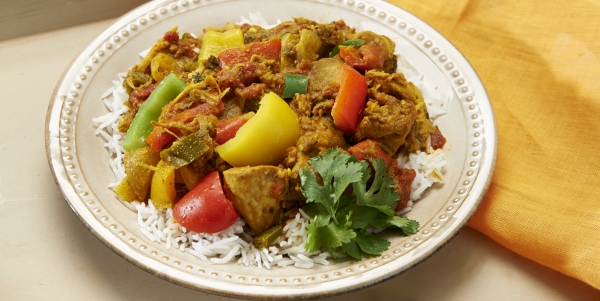
According to a recent survey, Chicken Jalfrezi has now become England's most popular takeout food (which they call "take away"), supplanting the milder and saucier Tikka Masala as a British favorite. Several observers have noted that British are increasingly seeking out spicier food. Jalfrezi hails from the north of India but it can be found in Pakistan as well. Folk etymologies abound for the origin of the name "Jalfrezi". Some think the curry was highly influenced by Chinese food. Chinese food in India is far different than what is found elsewhere in the world. This version of Jalfrezi uses chicken but other meats, Indian paneer cheese or vegetables (garbanzo beans, broccoli, peas etc.) can be used in place of the chicken. Unlike other curries, the vegetable and meat pieces are cut medium-large. There are several commercially available Jalfrezi sauces, but the basic spices are easy to come by—and everything tastes better fresh rather than from a bottle. As always, feel free to experiment. Jalfrezi is very easy to make, keeps well and tastes even better the day after it's made. Using brightly colored bell peppers makes it look a bit brighter in color than many Indian curries. Jalfrezi is also thicker and drier. This recipe uses Serrano chilies, for a milder dish use fewer chilies or substitute Jalapenos or ground chili. Jalfrezi is usually eaten with long-grained Basmati rice and/or naan.
Ingredients:
- 2 medium chicken breasts, cut in to medium sized cubes
- 1 tablespoon ground cumin
- 1 tablespoon ground coriander
- 1 tablespoon turmeric
- 2 tablespoons vegetable oil or ghee
- 1 onion sliced
- 1 red Bell Pepper, seeded and cut into medium sized pieces
- 1 yellow Bell Pepper seeded and cut into medium sized pieces
- 3 Serrano chilies, de-seeded and sliced thin.
- 2 garlic cloves, chopped
- 1 (14.5 ounce) crushed tomatoes or 2 cups of finely chopped fresh tomatoes)
- 2 tablespoons grated fresh ginger root
- 1/2 cup chopped cilantro leaves
- red chili powder, to taste (optional)
- Salt (to taste)
Preparation:
- In a bowl coat the chicken with the ground cumin, ground coriander, turmeric and chili powder (optional).
- Heat the oil or ghee in a large deep skillet over medium-high heat.
- Add onions, Bell Peppers, chilies and garlic, and cook until the onions become translucent.
- Add the seasoned chicken.
- Fry gently, turning the chicken frequently.
- Add tomatoes with their juice, cover the pan, and simmer over medium heat for 20 minutes.
- Uncover, and simmer for another 10 minutes to evaporate most of the excess liquid.
- Add ginger and cilantro, and simmer for another 5 to 7 minutes.
- Add salt to taste.
Serve over Basmati rice and/or with Indian naan.
Recipe by Tom Johnston-O'Neill
Photo by Heidi Adams
- Details
- Hits: 5859
Joomla!
Extensions
The Joomla! content management system lets you create webpages of various types using extensions. There are 5 basic types of extensions: components, modules, templates, languages, and plugins. Your website includes the extensions you need to create a basic website in English, but thousands of additional extensions of all types are available. The Joomla! Extensions Directory is the largest directory of Joomla extensions.
Components
Components are larger extensions that produce the major content for your site. Each component has one or more "views" that control how content is displayed. In the Joomla administrator there are additional extensions such as Menus, Redirection, and the extension managers.
Modules
Modules are small blocks of content that can be displayed in positions on a web page. The menus on this site are displayed in modules. The core of Joomla! includes 24 separate modules ranging from login to search to random images. Each module has a name that starts mod_ but when it displays it has a title. In the descriptions in this section, the titles are the same as the names.
Content Modules
Content modules display article and other information from the content component.
User Modules
User modules interact with the user system, allowing users to login, show who is logged-in, and showing the most recently registered users.
Display Modules
These modules display information from components other than content and user. These include weblinks, news feeds and the media manager.
Utility Modules
Utility modules provide useful functionality such as search, syndication and statistics.
Navigation Modules
Navigation modules help your visitors move through your site and find what they need.
Menus provide your site with structure and help your visitors navigate your site. Although they are all based on the same menu module, the variety of ways menus are used in the sample data show how flexible this module is.
A menu can range from extremely simple (for example the top menu or the menu for the Australian Parks sample site) to extremely complex (for example the About Joomla! menu with its many levels). They can also be used for other types of presentation such as the site map linked from the "This Site" menu.
Breadcrumbs provide users with information about where they are in a site.
Page 26 of 32