
We return to Thailand for this month's recipe and one of my favorite soups, Tom Kha. This delicious soup is a standard offering in nearly all Thai restaurants; once you gather all the proper ingredients, it is very easy to prepare.
- Details
- Hits: 6377
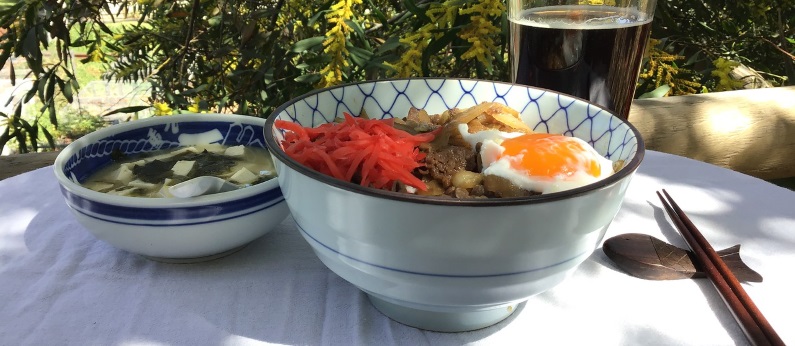
Buddhism was introduced into Japan in the 6th century. One of the early precepts of Japanese Buddhism was the prohibition of eating meet. Prior to that time, people in Japan ate wild boar, deer or domesticated pigs. In 675CE the Emperor Tenmu banned eating meat altogether. A full one thousand years later during the Edo Period (1603-1868), meat eating re-entered Japanese culture in the form of cures for various ailments. In 1852-3, just prior to the end of the Edo Period, American Commodore Matthew Perry visited Japan during a time when the country was extremely isolationist. He was ordered to force open trade with the Japanese, but the Japanese rebuffed him, biding him to return a year later to learn the Japanese official response to Perry's proposal to establish trade relations. He returned in only 6 months with 10 warships and 1600 men to force the issue under the theory of "manifest destiny". A series of missteps ensued, but on March 31, 1954, the Treaty of Kanagawa was signed, establishing trade relations. Subsequently, there was a move to re-instate the emperor to power, resulting in the Meji Restoration. Japanese warily embraced aspects of Western culture, and in 1872, it was announced that the Emperor himself had eaten beef, and there was an official campaign to promote meat eating to increase the health and physical stature of Japanese citizens (particular soldiers). It was thought this could be achieved through daily consumption of meat as was the custom in the West. Eventually a form of beef hotpot, Gyū-nabe, became quite popular in Japanese restaurants of the time. By 1877 there were nearly 600 restaurants in Toyko alone that specialized in beef dishes. Gyudon is the precursor to the more elaborate Sukiyaki, both employing a sauce made from soy sauce (shoyu), fermented rice wine (mirin), higher alcohol rice wine(sake), sugar and bonito stock (dashi). One website has dubbed the gyudon as "Japans most fool-proof dish." The dish typically employs relatively inexpensive cuts of beef (ribeye or chuck) making it a cheap meal (under $5), however, the Origami restaurant in Tokyo sells Waygu beef version using Waygu beef that costs $50 a bowl.
The first restaurant in Japan to specialize exclusively in gyudon was Yoshinyo at the Tokyo Nihonbashi fish market which began serving in 1899. It may have been the first instance of Japanese fast-food and was then called Gyumeshi (beef rice). Today, Yoshinoya operates a large chain of gyudon restaurants in Asia and the United States including several in the San Diego area. But the largest chain—over 2,000 outlets—specializing in gyudon is Sukiya, with restaurants throughout Asia, and in Brazil and Mexico.
Gyudon requires thinly sliced beef (round, ribeye or chuck). You can buy pre-cut beef for it at Asian markets, use beef sliced for Philly Cheesesteaks or slice the beef yourself. If you decide to do your own slicing, it is highly advantageous to slice partially frozen beef which will allow you to make the thinnest slices.
Onsen Tamago is a Japanese-style poached egg. "Osen" is a Japananes hot spring, but the word also refers to country hot spring spas. Traditionally "osen eggs" were cooked in the hot water from a hot spring. However, you can easily approximate them at home. Put 2 to 3 (depending on how many servings you desire) in a pot. Fill the pot with boiling water and cover for 20 minutes. If not using the eggs immediately, drop them in a bath of ice water. Some people forego poaching the egg, preferring it raw, and others like them sunny-side up. But in all cases, a runny yolk is desirable.
This recipe calls for the common Japanese fish broth known as dashi which is used in a number of different dishes including miso shiro soup. It can be made a variety of way, 1. By briefly simmering katsuobushi fish flakes and a piece of Konbu seaweed, (see the link for miso shiro below). 2. Use dashi "tea bags" (very convenient) or 3. most commonly from a packet of powered hondashi soup stock.
If you use sweet sake you might try reducing the sugar in the recipe to a teaspoon.
Beni-shoga (red pickled ginger) and Shichimi Togarahi powder can be bought in an Asian or Japanese market, although some non-specialty supermarkets have one or both. Shichi is "seven" in Japanese and Shichi-mi Togarahi is a 7-flavor blend of powdered chili, roasted and powdered orange rind, ground sansho (Japanese "pepper"), black and white sesame seeds, hemp seed, ground dry ginger, powdered nori (seaweed) and poppy seed.
Lastly, in Japan gyudon is almost always served with a bowl of Miso Shiru soup, a recipe for which can be found here.
Ingredients:
- 1/2 pound (225g) thinly shaved beef ribeye or chuck steak (see note)
- 1 medium onion
- 1/2 cup homemade dashi, or the equivalent in Hondashi (see note)
- 1/4 cup dry sake
- 2 tablespoons soy sauce
- 1 tablespoon sugar, plus more to taste
- 1 teaspoon grated fresh ginger
- 1/4 cup thinly sliced daikon (Japanese radish) - optional
- 2 - 3 raw eggs (don't break)
- 2 cups Japanese short grain rice
- Beni-shoga (red pickled ginger)
- Shichimi Togarashi mixed chili pepper powder
Preparation:
- Bring a pot of water to a boil to prepare the eggs.
- Place eggs (not shelled yet!) in a medium pot, fill will boiling water and cover. Set timer for 20 minutes and read note above.
- Prepare the rice according to package directions.
- Slice the onion into thin crescents.
- Slice the daikon into thin slices. (optional)
- In a medium-size pan, combine the onion, daikon, sake, soy sauce, sugar and dashi and bring to a simmer.
- Simmer ingredients for 5 minutes stirring frequently.
- Mix in the sliced beef and simmer for an additional 5 minutes, again stiff frequently.
- If the mixture starts to get dry, add some water or bonito stock to the pot.
- Add sliced ginger and cook for an additional minute. (note, adding the ginger at the end will retain its "kick".)
- Serve over cooked Japanese short grain rice. (makes 2 - 3 bowls)
- Break an onsen egg over each bowl.
- Garnish with Beni-shoga and a light dusting of Shichimi Togarashi powder.*
Itadakimasu!(いただきます)
Recipe by T. Johnston-O'Neill
Photos by Shari K. Johnston-O'Neill
Some historical information summarized from Yoshoko Roots Story (Plenus "kome" Academy).
* Note: We forgot to sprinkle the Shichimi Togarshi on before we took the photos!

- Details
- Hits: 6216
The Recipe of the Month is Hawaiian Saimin, a light soup that is considered one of the signature dishes of Hawaii. With only a handful of ingredients, it is a delicious and easy-to-prepare soup for those in a hurry!
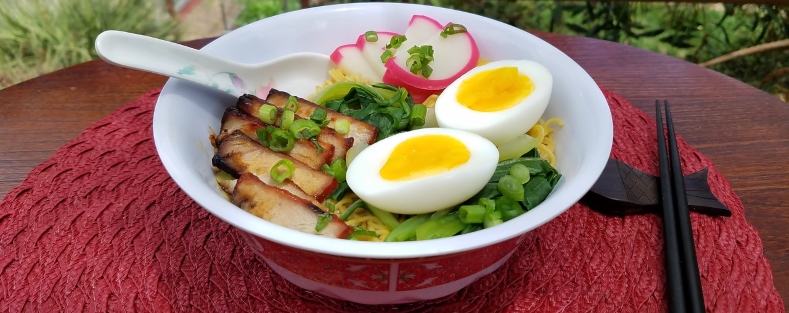
The word "saimin" is a contraction of the Chinese words for "thin" and "noodle". The precise origins of saimin are in dispute, but the dish has been in existence from the early 1900s. Beginning in the 1890s sugar cane became the biggest export crop in Hawaii. The plantations that grew sugar cane were almost entirely owned or operated by Americans. At this point virulent diseases such as gonorrhea, syphilis, yaws, measles and tuberculosis, first brought to the islands by Captain Cook's sailors, laid utter waste to the Hawaiian population. But the sugar cane plantations needed laborers. By the early 20th centuries thousands of contract laborers from China, Portugal, Japan, the Philippines, Korea, Puerto Rico and Okinawa worked the plantations and most remained. There are many competing theories on the origin of saimin including that it evolved from exchanges of food items across cultural and ethnic lines, was introduced by Japanese people who longed for ramen or was a dish created by Chinese laborers and eventually spread throughout the plantations
The earliest written mentions of saimin say that it was a dish enjoyed by plantation workers and was initially sold from mobile "saimin wagons" that were pushed from field to field and plantation to plantation. When the Hawaiian economy became more and more service-based saimin eateries moved to the towns and cities and became popular fair at schools, sporting events and movie theaters. In the 1960's entrepreneur Maurice Sullivan open 12 McDonalds restaurants in Hawaii which became immensely popular. Sullivan invited McDonalds executives, including CEO Ray Kroc to Hawaii and took them all to a humble "hole in the wall" saimin eatery and Sullivan convinced Kroc to allow him to add saimin to his franchised MacDonalds. It was the first time that any MacDonalds served local foods and saimin is still being sold at MacDonalds and is still a very popular meal. Nowadays saimin can be found in all sorts of restaurants in Hawaii and it no long exclusively associated with cheap and fast food
Like many famous dishes, there are lots and lots of variations when it comes to saimin. The first and perhaps most important variation is in the soup stock. Many if not most recipes call for the use of the umami-rich Japanese soup base flavoring, dashi. However, there are several types of dashi that have different main ingredients. Kombu dashi is made from dried kombu seaweed. It has a mild flavor. Katsuo dashi is made from katsuobushi, dried shaving from a fermented bonito tuna which requires a months-long process to manufacture and can be found in powder or flake form. The flakes are used for a variety of Japanese dishes and, if sprinkled on soup or a plate of hot yaki-soba, the flakes will "dance". Awase, which means "mixed" in Japanese and Awase Dashi, found in powdered form, is a combination of kombu seaweed and katsuobushi fish flakes. Iriko Dashi is made from dried anchovies and shitake dashi, not surprisingly are made from shitake mushrooms. Some recipes call for using plain chicken or fish stock. This recipe uses home-made dashi, but you can substitute any of the other versions if you so like. Lastly, some claim that the original saimin broth was made from dried shrimp stock, and our broth adds this element
Saimin is often referred to as "Hawaiian Ramen", but that is rather inaccurate. Saimin noodles, often purchased fresh rather than dried, are a straight wheat and egg noodle most similar to Chinese egg noodles. Ramen noodles are dried, curly and are made of wheat without eggs.
The two most popular protein additions to saimin are either kamaboko, a homogenous white fish cake that has a dyed-red outer surface, char-siu roast pork (which also has a dyed-red exterior) or spam which is enormously popular in Hawaii. Halved boiled eggs are popular, and some versions include wontons or sliced Japanese-style omelets. Sometimes it is topped with pieces of fried chicken.
The most popular version of saimin is a soup, but using the same ingredients except the broth, it can be prepared as a fried dish.
Asian ingredients can be found in any Asian/Chinese or Japanese grocery stores.
For more vegetables, you can add thinly sliced carrots, bok choi, spinach or cabbage
Saimin Broth
If you wish to use dashi powder (or granules), follow package instructions. However, unless you can read Japanese, this might be a problem as some brands don't include instructions in English. Typically, the ratio of dashi to water ratio is 1/2 to 1 teaspoon of dashi powder to one cup of water, but if you don't have package instructions, you should experiment to find the right ratio so that your soup base is not too weak or too strong.
I purchased the ingredients for this recipe at 99 ranch market. Kamaboko can be found in the middle of aisle 1 (in the Clairemont Mesa store), the dried shrimp and noodles can be found in aisle 10 and the shitake mushrooms and katsuobushi and konbu can be found on aisle 7? (not sure). Bok choi and scallions can be found on the back wall of the produce section. I made my own char sui from thick-sliced pork marinaded in char sui sauce (overnight) and roasted for 1 hour at 350° F.
Broth Ingredients:
- 8 cups of water
- 2 pieces of kombu
- 1 cup dried shrimp
- 1 cup katsuobushi
- 1/4 dried sliced shitake mushrooms
- 1/4 cup shoyu (Japanese Soy Sauce)
- 1 Tablespoon salt
Broth Preparation:
- Bring water to boil
- Add kombu, dried shrimp, katsuobushi, shitake mushrooms, soy sauce and salt
- Simmer for 10 minutes
- Mix in shoyu (soy sauce)
- Lower heat to the very lowest setting and steep for an additional 30 minutes
- With a fine strainer, strain the broth
Ingredients:
- 8 cups of dashi stock (homemade or from dashi powder)
- 1 pound of thin Chinese egg noodles
- 2 Tablespoons soy sauce
- 1 Tablespoon finely grated ginger
- 4-6 spring onions (scallions), thinly sliced
- 4 ounces of kamaboko fish cake, sliced 1/8 inch thick
- 4 ounces of char-sui pork, sliced 1/18 inch thick (optional)
- 6 hard-boiled eggs cut lengthwise in half (optional)
- 6 pieces of bok choi, roughly chopped
Preparation:
- Hard boil the eggs; let the eggs cool, shell, and slice into halves.
- Cut off root ends of bok choi and then slice into 1 inch lengthwise pieces.
- Add the dashi stock, sliced bok choi, finely grated ginger and water to a pot and bring to a low simmer for 5 minutes.
- Cook the noodles in a separate pot and when done add to the dashi stock along with the soy sauce.
- Divide noodles and stock into 6 bowls.
- Top with egg halves, sliced scallions, kamaboko and char-sui slices.
Enjoy!
Recipe by T. Johnston-O'Neill
Photos by Shari K. Johnston-O'Neill
- Details
- Hits: 6091
California Youth Conservatory Theatre is a dynamic and innovative, non-profit company with unique and effective programming. They change lives and futures through Performing Arts.
CYC Theatre is not just "Another Children's Theater", but a unique organization which is making a difference in the lives of its participants. From the first-time student performer to the famous stage or film actor, people are impressed with the quality of what our company offers. Not only their performances, but the overall experience of their programming has people talking.
For more information,
call: (619) 944-7574 or visit: www.cyctheatre.webs.com
- Details
- Hits: 5967

Chronos Theatre Group, a 501(c)3 non-profit organization, is a multi-cultural, multi-arts ensemble of actors, musicians, dancers, and visual artists.
Chronos Theatre Group seeks to bring together diverse audiences through theatre, music, dance, and visual arts by performing classical and historical works from various world cultures and time periods.
For more information:
Call: (619) 981-4179
or
Email:
or
Visit: www.chronostheatre.com
- Details
- Hits: 5130
Joomla!
Extensions
The Joomla! content management system lets you create webpages of various types using extensions. There are 5 basic types of extensions: components, modules, templates, languages, and plugins. Your website includes the extensions you need to create a basic website in English, but thousands of additional extensions of all types are available. The Joomla! Extensions Directory is the largest directory of Joomla extensions.
Components
Components are larger extensions that produce the major content for your site. Each component has one or more "views" that control how content is displayed. In the Joomla administrator there are additional extensions such as Menus, Redirection, and the extension managers.
Modules
Modules are small blocks of content that can be displayed in positions on a web page. The menus on this site are displayed in modules. The core of Joomla! includes 24 separate modules ranging from login to search to random images. Each module has a name that starts mod_ but when it displays it has a title. In the descriptions in this section, the titles are the same as the names.
Content Modules
Content modules display article and other information from the content component.
User Modules
User modules interact with the user system, allowing users to login, show who is logged-in, and showing the most recently registered users.
Display Modules
These modules display information from components other than content and user. These include weblinks, news feeds and the media manager.
Utility Modules
Utility modules provide useful functionality such as search, syndication and statistics.
Navigation Modules
Navigation modules help your visitors move through your site and find what they need.
Menus provide your site with structure and help your visitors navigate your site. Although they are all based on the same menu module, the variety of ways menus are used in the sample data show how flexible this module is.
A menu can range from extremely simple (for example the top menu or the menu for the Australian Parks sample site) to extremely complex (for example the About Joomla! menu with its many levels). They can also be used for other types of presentation such as the site map linked from the "This Site" menu.
Breadcrumbs provide users with information about where they are in a site.
Page 17 of 32